What to Look For in Lion's Mane Supplement UK 2026
Reading a UK lion's mane label well is one of the highest-leverage skills for getting genuinely effective supplementation. The skills aren't complicated — once you know what to check, you can evaluate any UK lion's mane product in under 30 seconds.
At a glance: our picks
- First check: 'Fruiting body extract' on label
- Second check: Stated extraction ratio (5:1 or higher)
- Third check: 1000mg+ elemental fruiting body per serving
- Fourth check: UK BRC-accredited manufacturing
- Quick evaluation time: 30 seconds for 80% confidence
Reading a UK lion's mane label well is one of the highest-leverage skills for getting genuinely effective supplementation versus paying premium for filler-heavy products. The skills aren't complicated — once you know what to check, you can evaluate any UK lion's mane product in under 30 seconds. This guide covers the specific things to look for on the bottle, the supplement facts panel, and the brand's product page.
Pairs with our practical buying guide which covers where and when to buy. This guide focuses specifically on the label-reading skills.
Our top picks reviewed
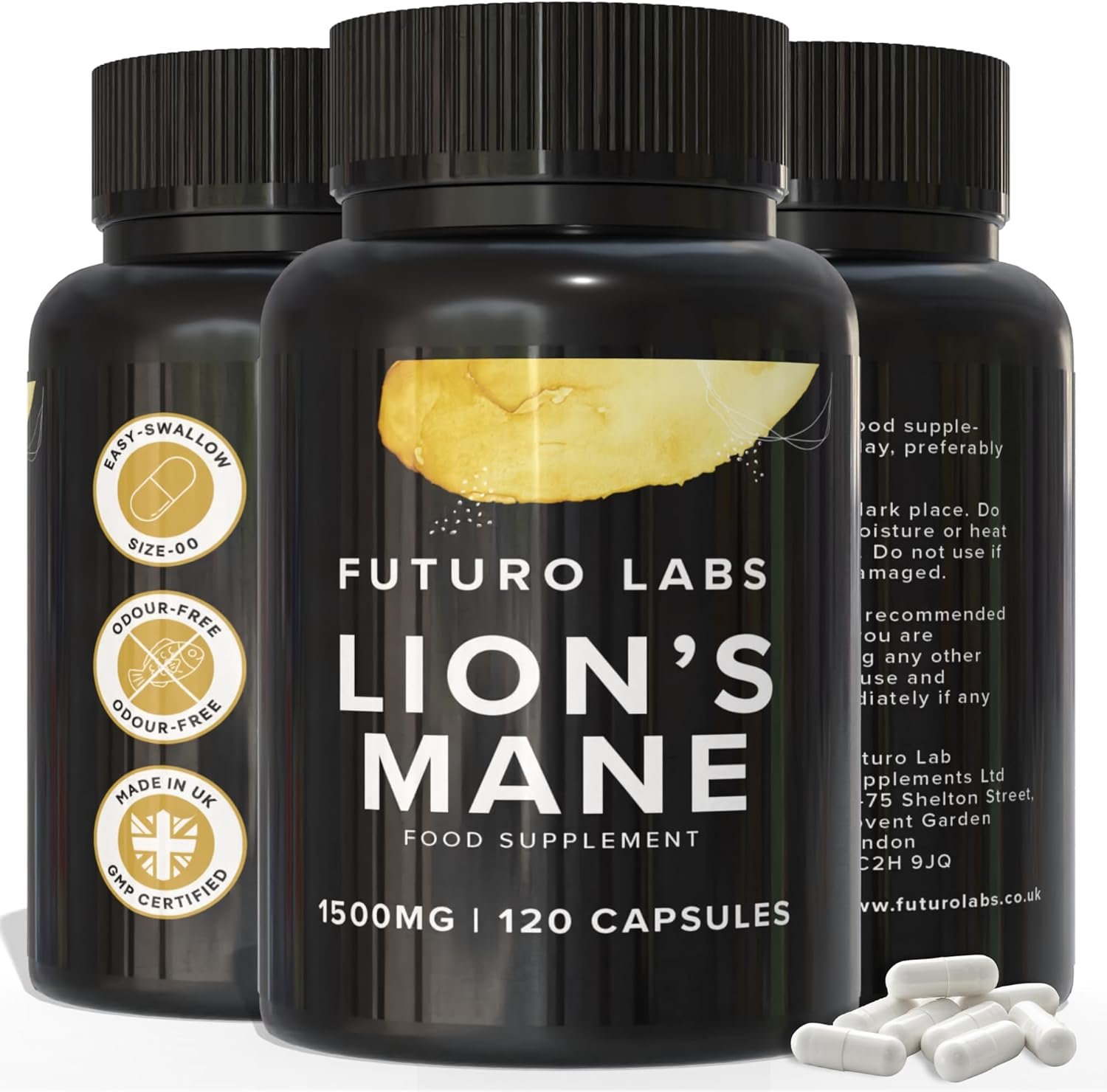
Futuro Labs Lion's Mane
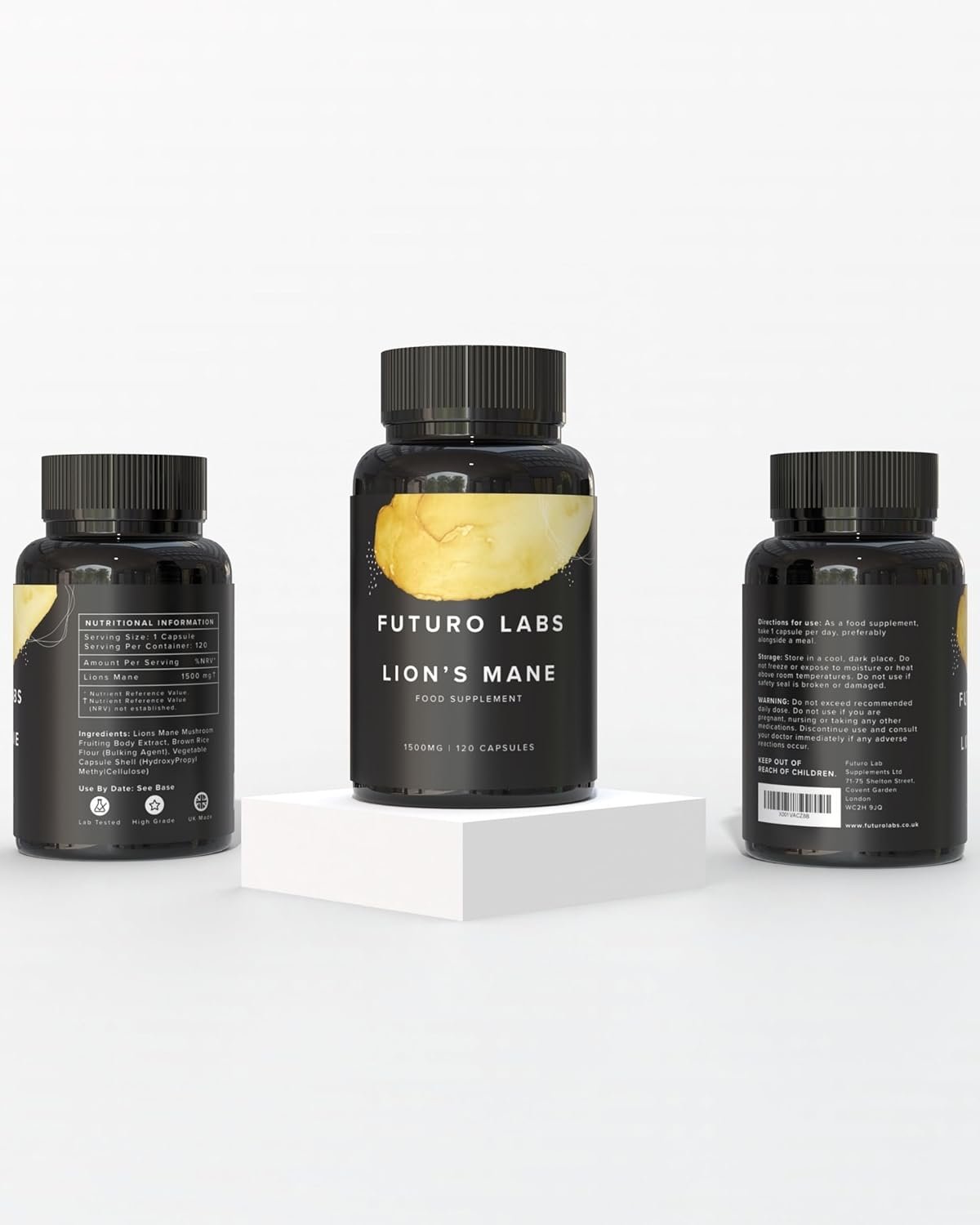
£15.49 for 120-day supply · 13p per day
Pros
- 1500mg fruiting body extract (5:1 ratio) per single capsule
- Delayed-release capsule for high absorption
- 21.6mm size-00 — easier swallow than most 1500mg formats
- 120-day supply at ~13p per day
- BRC AA accredited UK manufacturing
- Vegan HPMC, no fillers, odour-free, lab tested
Cons
- Single-ingredient (no nootropic blend)
- Newer brand vs heritage UK names
Available from: Amazon UK · Futuro Labs
Solve Labs Lion's Mane
Around £22-28 for 60-day supply · 37-47p per day
Pros
- Dual-extracted fruiting body
- UK manufactured
- Strong sourcing transparency
Cons
- Higher cost per day
- Smaller pack sizes
Available from: Solve Labs · Amazon UK
DIRTEA Lion's Mane
£30+ for 30 servings (powder) · £1+ per day
Pros
- Strong UK brand presence
- Multiple formats available
Cons
- Premium pricing
- Powder dosing less precise
- Capsules less prominent in range
At-a-glance comparison
| Label check | What good looks like | Red flag |
|---|---|---|
| Mushroom material | Fruiting body extract | Mycelium, mushroom blend |
| Standardisation | 5:1 extract ratio or higher | Unstandardised powder |
| Dose per serving | 1000mg+ extract | Sub-clinical 200-500mg |
| Manufacturing | UK BRC AA accredited | Unstated origin |
| Capsule shell | HPMC (vegan) | Gelatin (animal) |
| Claims | Supports normal cognitive function | Cure / treat / reverse |
| Per-day cost | Calculated at clinical dose | Bottle price only |
The primary spec checks (in order)
1. "Fruiting body extract" — non-negotiable
The label should specifically say "fruiting body extract" (the visible mushroom). Avoid:
- "Mycelium" alone — typically grown on grain substrate with substantial grain residue
- "Mushroom blend" or "full spectrum" without specifying fruiting body content
- "Mycelium and substrate" — explicitly grain content
- "Whole mushroom" — typically unstandardised powder rather than extract
Quality UK products disclose fruiting body content clearly because it's a competitive advantage. Brands using ambiguous framing typically have something to hide.
2. Stated extraction ratio (5:1, 8:1, 10:1)
Quality lion's mane is standardised to an extraction ratio indicating concentration relative to raw mushroom weight. 5:1 means 5kg of raw material concentrated to 1kg of extract — bioactive compounds proportionally concentrated. Avoid products that don't disclose extraction ratio: typically lower-quality whole mushroom powder rather than standardised extract. Full ratio explainer here.
3. Polyphenol or beta-glucan percentage (where disclosed)
Premium UK brands disclose standardised bioactive content — "30% polyphenols" or "25% beta-glucans" indicates verified active compound concentration. Not all quality brands disclose this; it's an additional quality signal where present rather than a deal-breaker if absent. Full polyphenol explainer here.
4. Elemental fruiting body content per serving
The actual milligrams of fruiting body extract delivered per recommended serving. Target 1000-3000mg daily for clinical dose tier. Watch for:
- "Per capsule" vs "per serving" — if recommended serving is 3 capsules, "per capsule" content needs multiplying
- Proprietary blends that don't disclose individual ingredient amounts
- Multi-ingredient nootropic blends where lion's mane is one minor component (Mind Lab Pro typically 500mg in 11-ingredient blend)
Manufacturing and quality checks
5. UK BRC accreditation
BRC (British Retail Consortium) is the UK supplement industry quality standard. Grades ascend: BRC, BRC A, BRC AA. BRC AA is the highest food-safety grade routinely awarded — sites at this grade undergo unannounced audits and operate quality systems comparable to pharmaceutical-grade production. FL operates at BRC AA. Most UK supplement brands use lower BRC grades or BRC-accredited contract manufacturers.
6. Country of manufacture
"Manufactured in the UK" is meaningful. Some UK brands manufacture in EU under different regulatory frameworks; some import from US, China, or other regions. UK manufacturing means UK FBO (Food Business Operator) accountability, UK regulatory oversight, and ability to recall efficiently if needed.
7. Third-party testing
Premium UK brands disclose third-party testing for:
- Heavy metals (lead, mercury, cadmium, arsenic) — particularly relevant for mushroom products
- Microbial contamination
- Pesticide residues
- Verified active compound content
Testing certificates available on request is a positive signal; brands unwilling to share are a yellow flag.
Other ingredient checks
8. Capsule shell material
HPMC (hydroxypropyl methylcellulose) vegetable shell is vegan-suitable and pharmaceutically-standard. Gelatin shells are animal-derived. Most quality UK brands use HPMC for vegan compatibility.
9. Fillers and excipients
Magnesium stearate (flow agent) is widely used but not strictly harmful — its presence indicates lower-cost manufacturing. Brown rice flour, microcrystalline cellulose (MCC), or rice bran are common bulking agents — generally acceptable. Avoid:
- Titanium dioxide (banned in EU food applications; some UK supplements still use)
- Artificial colours, preservatives, or sweeteners (unnecessary in capsule format)
- "Proprietary blend" without ingredient disclosure
10. Allergen disclosure
UK regulations require allergen disclosure on supplement labels. Common allergens to check: gluten, soy, dairy, nuts. Quality UK brands explicitly state "free from" common allergens where applicable.
Brand-level checks
11. Brand transparency
Quality UK brands publish:
- Sourcing information (where the mushroom material is grown)
- Manufacturing location and accreditation
- Testing protocols
- Founders' / company information
- Customer service contact (UK phone or email, not just contact form)
12. Independent reviews
Check Amazon UK 3-star reviews specifically — these are typically the most informative (5-star skews early-enthusiast, 1-star skews shipping issues). Independent supplement review sites with reasonable editorial independence are worth checking but the supplement review space has substantial affiliate influence.
Red flags to walk away from
- "Cure", "treat", "reverse" claims — UK regulations prohibit these for supplements
- "Doctor recommended" without specifying which doctor or clinical trial
- Claims about "no side effects ever" — every supplement has some user response variation
- Excessive testimonials without verifiable sources
- Price drops marketed as "limited time" perpetually
- Multi-level marketing (MLM) brands — typically inflated pricing for proportional pyramid commissions rather than product quality
- Brands without a permanent UK business address or registered company
30-second evaluation checklist
For UK shoppers evaluating a new lion's mane product on Amazon or direct:
- "Fruiting body extract" stated? (5 seconds)
- Extraction ratio disclosed? (5 seconds)
- Elemental fruiting body per serving 1000mg+? (5 seconds)
- UK BRC-accredited manufacturing? (5 seconds)
- Calculate per-day cost at recommended serving (5 seconds)
- Read 2-3 Amazon UK 3-star reviews (5 seconds skim)
30 seconds gets you 80% of the way to an informed evaluation. The remaining considerations (third-party testing, brand transparency) matter for premium positioning but the first six checks identify the genuine quality tier.
Frequently asked questions
What should I look for in lion's mane supplement?
Six primary checks: (1) 'fruiting body extract' specifically — not mycelium or whole mushroom powder; (2) stated extraction ratio (5:1, 8:1, 10:1); (3) polyphenol or beta-glucan percentage where disclosed; (4) elemental fruiting body content per serving (target 1000-3000mg daily); (5) UK BRC-accredited manufacturing; (6) per-day cost at recommended serving. These six checks identify quality tier in under 30 seconds.
What does 'fruiting body' mean on a lion's mane label?
Fruiting body refers to the visible mushroom — the part above ground containing concentrated bioactive compounds (hericenones in lion's mane fruiting body, erinacines primarily in mycelium). Quality UK lion's mane products use fruiting body extract specifically. Products labelled 'mycelium' or 'mycelium and substrate' are typically grown on grain with substantial grain residue rather than concentrated active mushroom content.
How do I read a lion's mane supplement label UK?
Start with the supplement facts panel — verify 'fruiting body extract' specifically, check the elemental milligrams per serving, look for stated extraction ratio (5:1 or higher). Check ingredient list for fillers (magnesium stearate, artificial colours) and allergens. Check the bottle for manufacturing country and any BRC accreditation. Calculate per-day cost at recommended serving rather than focusing on bottle price.
What lion's mane should I avoid?
Products labelled 'mycelium' or 'mycelium and substrate' (typically grain residue); whole mushroom powder products at typical 500-1500mg servings (sub-clinical dose); proprietary blends not disclosing lion's mane content; products making 'cure' or 'treat' claims (prohibited by UK regulations); brands without permanent UK business address; products without country-of-manufacture disclosure; cheap sub-£10 products at typical pack sizes (almost always indicates lower-quality ingredients).
Looking for the best value lion's mane in the UK?
Futuro Labs Lion's Mane delivers 1500mg fruiting body extract (5:1) in a delayed-release capsule for ~13p per day.
Shop on Amazon UKLast updated: 10 May 2026. All content is provided for general information only and is not intended to substitute for professional medical advice. If you have any health concerns, consult your GP or a qualified healthcare professional. Futuro Labs is a registered UK supplement manufacturer (Futuro Lab Supplements Ltd, 71-75 Shelton Street, London WC2H 9JQ). Affiliate links to Amazon UK and our own store are clearly disclosed.