Flaxseed: A Truce, Not a Victory
The conversion truth that sorts 'plant omega 3' labels — with flax credited fully for the job that's actually its own.
At a glance
- Two jobs, one family: flax = ALA's own claim · fish/algal = the EPA/DHA payload
- The conversion truth: ALA → EPA in low single digits, onward to DHA lower — real, rounding-error
- Flax's honest card: the 2g ALA cholesterol-maintenance claim — met by flax easily
- The verdict: flax as food, marine payload met directly — no versus required
One family, two currencies — the split this page turns on
Flax versus fish oil reads as a rivalry and resolves as a division of labour: both carry omega-3, but different members — flax leads the plant side with ALA (alpha-linolenic acid), fish and algal oils carry the long-chain marine pair EPA and DHA — and the family tree's quiet fact does all the sorting: ALA converts to EPA at low single-digit percentages in most people, and onward to DHA lower still, meaning tablespoons of flax oil yield marine-omega amounts a single softgel embarrasses (the family in full, the pair's jobs). Real conversion, rounding-error scale: the reason 'plant omega 3' front labels need their panels read twice, and the reason this comparison ends in routing rather than victory.
Flax's honest card — a claim of its very own
What flax holds that this page credits properly: ALA is essential in its own right — a dietary requirement, not a lesser omega — and it carries its own authorised sentence: ALA contributes to the maintenance of normal blood cholesterol levels, conditioned on 2g daily — an intake flaxseed meets easily (a tablespoon of ground flax or a modest oil serving clears it), giving the plant side a register entry the marine pair doesn't duplicate (the marine ladder it sits beside). The whole-food case stacks on top: ground flax, chia and walnuts arrive as foods — ALA plus fibre, lignans and the rest of the package — earning kitchen places on merits no capsule conversation captures. Flax's honest limitation is simply scope: its claim is its own, its conversion is decorative, and the marine conditions — 250mg EPA+DHA for the heart sentence, DHA's gates above — stay unmet by any realistic flax intake (the sentence this label holds instead).
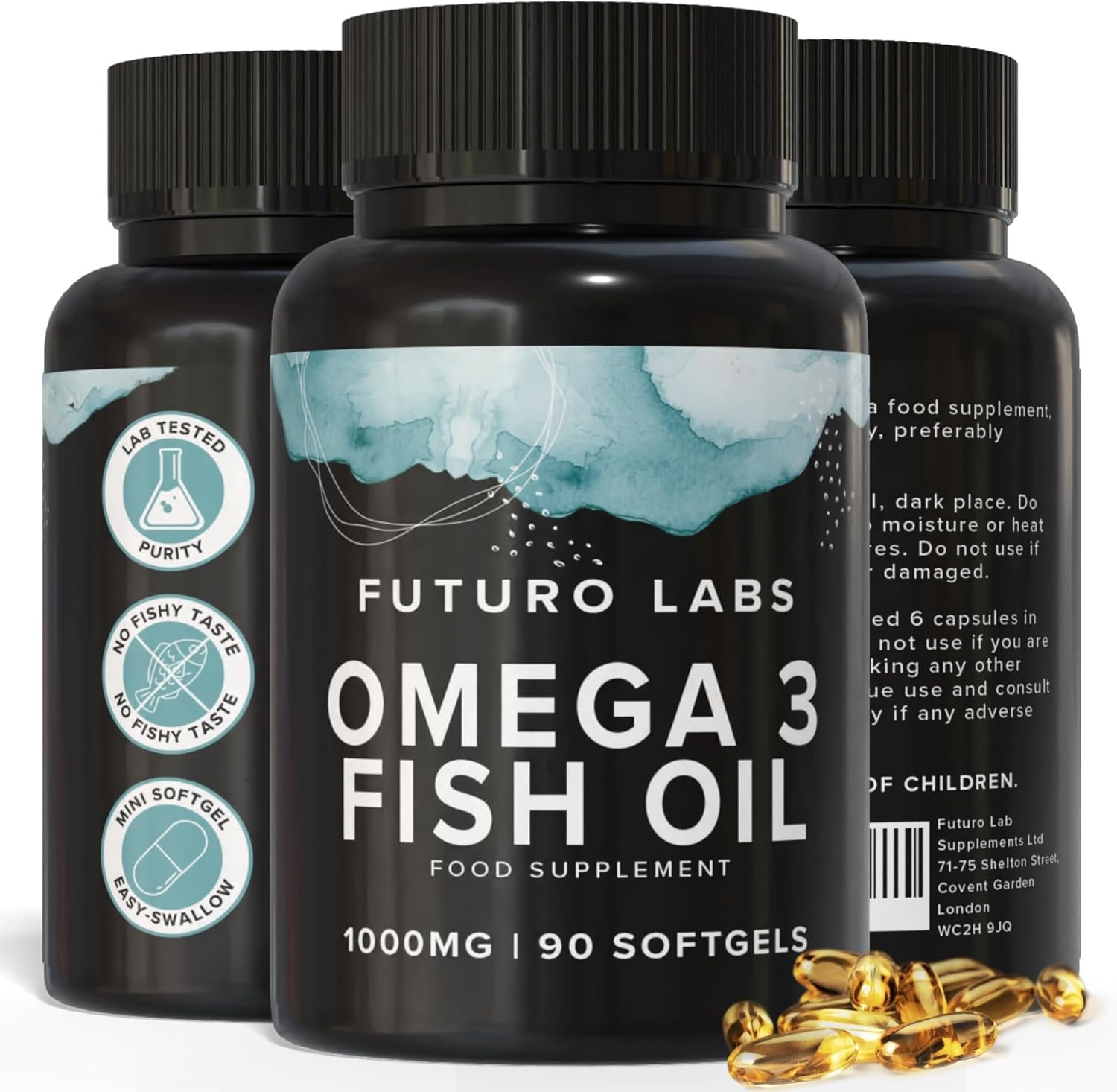
Futuro Labs Omega 3 Fish Oil
£14.99 for 90-day supply (90 softgels) · ~17p per day
Pros
- 1000mg fish oil per softgel — 180mg EPA + 120mg DHA stated
- Mini softgel, no fishy taste, lab tested
- 90-day supply at £14.99 (~17p/day), UK made
Cons
- Fish-derived, bovine-gelatin softgel — not vegan or vegetarian (algal DHA is that route)
- Ethyl-ester form — take with a meal; DHA brain/vision register claims need 250mg DHA daily, above the one-a-day serving
Available from: Amazon UK — £14.99
The stack, the vegan note, and the close
Resolving the versus into a plate: run both as foods and jobs — flax, chia and walnuts in the kitchen for ALA's claim and the whole-food package; the EPA/DHA line met directly, one Futuro Labs Omega 3 softgel with a meal covering the everyday condition at ~17p (the chemistry, the record) — no conflict, no sequencing, shared breakfasts throughout. The vegan note this page owes: plant-based readers sometimes lean on flax precisely to avoid fish, and the conversion maths makes that a thin bridge — the honest fish-free route to the marine pair is algal oil, same molecules, no fish (that page's whole routing), with flax staying valuable for exactly what it is. Constants: freshness matters to flax oil too — it oxidises enthusiastically, small bottles and fridges are its friends (the storage logic shared); gates as ever — pregnancy, nursing or any medication → doctor first per the label (the conversation). Flax versus fish oil, closed as a truce: two currencies, two claims, two jobs — and a plate with room for both done honestly.
Frequently asked questions
Is flaxseed oil as good as fish oil for omega 3?
Different jobs wearing one family name: flax supplies ALA — genuinely essential, with its own authorised claim (ALA contributes to the maintenance of normal blood cholesterol levels, at 2g daily, which flax meets easily) — but ALA converts to EPA/DHA at low single-digit percentages, making flax a poor marine-omega strategy. Flax for ALA's own job; fish or algal oil for the EPA/DHA payload.
How inefficient is the ALA conversion really?
The quiet fact that sorts the aisle: conversion to EPA runs in low single digits for most people and onward to DHA lower still — tablespoons of flax oil yield marine-omega amounts a single softgel embarrasses. Real but rounding-error conversion is why 'plant omega 3' labels need reading twice.
Should I take flax as well as fish oil?
They stack without conflict — different acids, different claims, shared meals — and the honest question is culinary as much as supplemental: flax, chia and walnuts earn their place as foods (ALA plus fibre and the rest), while the EPA/DHA line gets met directly. Nobody needs both bottles; plenty of good diets effectively run both foods.