Omega 3: Essential Means It Arrives by Diet or Not at All
The rare family with real authorised sentences — every one conditioned, every condition printed, and maintenance grammar kept honest throughout.
At a glance
- The family: EPA + DHA (marine) · ALA (plant) — essential fats the body can't build from scratch
- The conversion truth: ALA → EPA/DHA runs inefficient — the marine pair is the working currency
- The register: heart at 250mg EPA+DHA · brain/vision at 250mg DHA — real, conditioned sentences
- Food first: two fish portions weekly, one oily — the supplement serves the plate that misses
The family, drawn properly — three members, two currencies
Omega 3 is a family name, and understanding the shelf starts with its members: EPA (eicosapentaenoic acid) and DHA (docosahexaenoic acid) — the long-chain marine pair, made by algae and concentrated up the food chain into oily fish, the forms your body actually deploys: EPA feeding signalling chemistry throughout the system, DHA serving as literal structure — a major building material of brain and retinal membranes, which is why it dominates the neurology and vision literature (the pair's own page); and ALA (alpha-linolenic acid) — the plant-side member from flax, chia, walnuts and rapeseed, essential in its own right but converted to the marine forms only inefficiently: low single-digit percentages by most estimates, which is the quiet fact that sorts the whole aisle — flax oil is genuine nutrition and a poor EPA/DHA strategy at once (that comparison). 'Essential' carries its textbook meaning throughout: none of these can be built from scratch internally — they arrive by diet, or they don't arrive.
Why this family is regulation's favourite — the conditioned sentences
What makes omega 3 unusual on this site: it's the rare supplement family holding real authorised UK claims — and they come dose-conditioned, which is where honest shopping lives. The everyday tier: EPA and DHA contribute to the normal function of the heart — conditioned on 250mg combined EPA+DHA daily, the register's own benchmark and the single most useful number on the shelf; DHA contributes to the maintenance of normal brain function, and of normal vision — each conditioned on 250mg DHA daily, a bar many one-a-day capsules (this site's included, at 120mg DHA) sit below and should say so. The high tier, register-real and practically distinct: maintenance of normal blood triglyceride levels at 2g EPA+DHA daily, and of normal blood pressure at 3g — multi-gram territory carrying its own do-not-exceed conditions, several capsules deep, and honestly adjacent to a GP conversation rather than a checkout (the complete ladder). The grammar note that keeps it all honest: every sentence above is maintenance language — contributes to normal function — not treatment or enhancement, and any label promising the latter has left the register (the evidence sort).
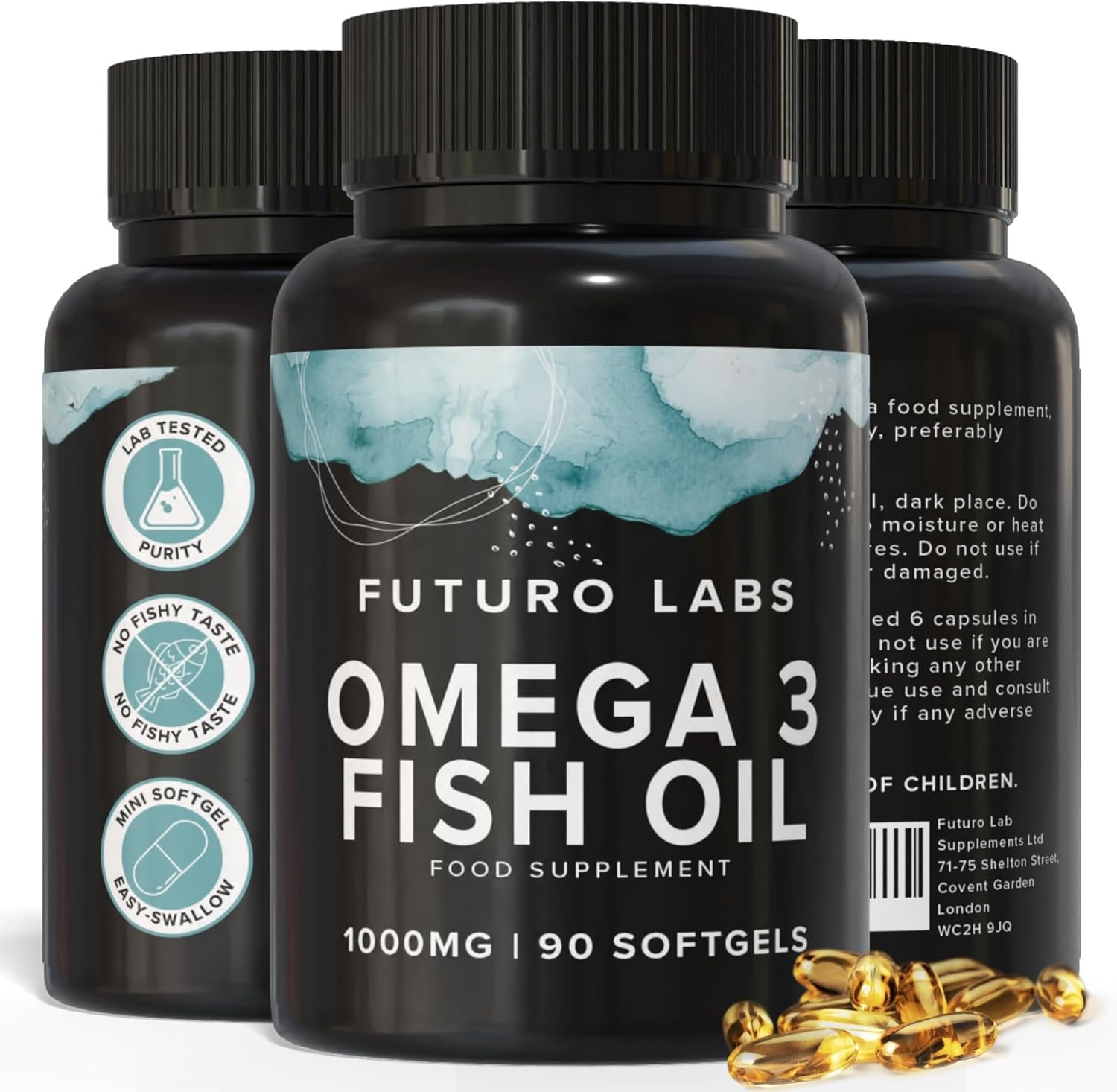
Futuro Labs Omega 3 Fish Oil
£14.99 for 90-day supply (90 softgels) · ~17p per day
Pros
- 1000mg fish oil per softgel — 180mg EPA + 120mg DHA stated
- Mini softgel, no fishy taste, lab tested
- 90-day supply at £14.99 (~17p/day), UK made
Cons
- Fish-derived, bovine-gelatin softgel — not vegan or vegetarian (algal DHA is that route)
- Ethyl-ester form — take with a meal; DHA brain/vision register claims need 250mg DHA daily, above the one-a-day serving
Available from: Amazon UK — £14.99
Food, gap, and the supplement's honest job
Where capsules genuinely fit, ordered correctly: the food answer first — UK guidance widely suggests two portions of fish weekly including one oily (salmon, mackerel, sardines, herring — the EPA/DHA-dense tier), and a plate reliably hitting that pattern has its marine base covered without this aisle (the foods page, the eat-fish honesty in full); the gap next — most UK plates don't reliably hit it, oily fish being the guidance line the national diet most consistently misses, which is the honest, unglamorous case for a base-layer capsule: Futuro Labs Omega 3 at 300mg EPA+DHA per mini softgel, one a day, £14.99 for 90 days at ~17p — the heart-claim condition met for the plate that wasn't meeting it (the record with limitations printed); and the boundaries always — the label's own gates route pregnancy, nursing and any-medication readers to a doctor before use (the classic conversation), vegans route to algal oil (the fish-free source of the same marine pair — that page), and felt-effects stay unpromised: these are maintenance fats on a weeks-to-months tissue clock, not a sensation (the timeline). What is omega 3, answered: an essential family, two working currencies, a register that names its prices — and a capsule whose honest job is covering the plate's most-missed line.
Frequently asked questions
What is omega 3, simply?
A family of essential polyunsaturated fats your body can't make from scratch: the marine pair EPA and DHA (fish and algae), and plant-side ALA (flax, chia, walnuts) which converts to the marine forms only inefficiently. 'Essential' is the operative word — these arrive by diet or not at all — and DHA in particular is structural: a building material of brain and eye membranes, not just a passenger.
Why do EPA and DHA get all the attention?
Two reasons: they're the forms the body actually deploys (ALA conversion runs at low single-digit percentages), and they're the forms the UK register attaches authorised sentences to — heart function at 250mg EPA+DHA daily, brain and vision at 250mg DHA daily. Supplement labels live and die on the EPA+DHA line, which most front-of-pack headlines skip.
Do I need a supplement or just food?
Food first, honestly: UK guidance widely suggests two portions of fish weekly including one oily — and a plate that reliably hits that has its marine omega-3 base covered. The supplement case is for the plate that doesn't: the fish-avoiders, the never-quite-manage-its — a base-layer product like Futuro Labs Omega 3 exists for exactly that gap, at 17p a day.