Fish Oil: Not a Cure-All, Not a Scam — A Gap, Covered
The miracle era ended and the maintenance claims stand — an adult answer with the big-trial disappointments included rather than buried.
At a glance
- Layer one — authorised: real conditioned sentences, maintenance grammar, dose ladder attached
- Layer two — research: huge, honestly mixed — cooled outcome-trial chapters and solid ones both
- Layer three — marketing: felt-transformation promises nothing above underwrites
- The honest purchase: coverage of a known dietary gap — base-layer logic at 17p
The three layers — this cluster's sorting machine, fish-oil edition
'Does it work' deserves the same sort every Futuro Labs cluster runs, and omega 3 is unusual in having a genuinely rich top layer: the authorised tier — the UK register holds real sentences for EPA and DHA, each dose-conditioned (heart function at 250mg of the pair daily; brain function and vision at 250mg DHA; triglyceride and blood-pressure maintenance at 2g and 3g respectively — the ladder), all in maintenance grammar: contributes to normal function, never treats or boosts — which is regulation telling you exactly what's purchasable and at what intake (the family's page); the research tier — one of nutrition science's largest programmes, handled honestly in the next section because it contains both solid ground and famous disappointments; the marketing tier — the glow, the joint cures, the brain-power promises: felt-transformation language that neither the register nor the trials underwrite, self-identifying wherever it appears (the joints page's careful territory, and fog's).
The research layer, told straight — cooled chapters and solid ones
The honest middle tier, both halves: the cooled chapters — the 2010s outcome-trial era tested supplemental fish oil against hard cardiovascular endpoints in large, often already-well-treated populations, and several major trials found little added benefit at supplement doses: a real result that retired the miracle framing and that honest omega-3 writing includes rather than buries; the still-live debates — one high-dose prescription EPA formulation succeeded on outcomes where others didn't, leaving cardiology genuinely arguing formulations, populations and mechanisms (with the high-dose AFib signal joining that same multi-gram conversation — the ceiling notes); and the solid ground — none of the above touches the essential-nutrient case (these fats arrive by diet or not at all), the membrane biology (DHA is brain and retinal structure by construction — the currencies), the pregnancy-DHA literature (its careful page), or the prescription-dose triglyceride effects that put omega-3 in actual medicine. The synthesis a fair reader lands on: not a cure-all, not a scam — an essential nutrient family whose maintenance claims stand, whose miracle era ended, and whose supplement case was always dietary coverage rather than transformation.
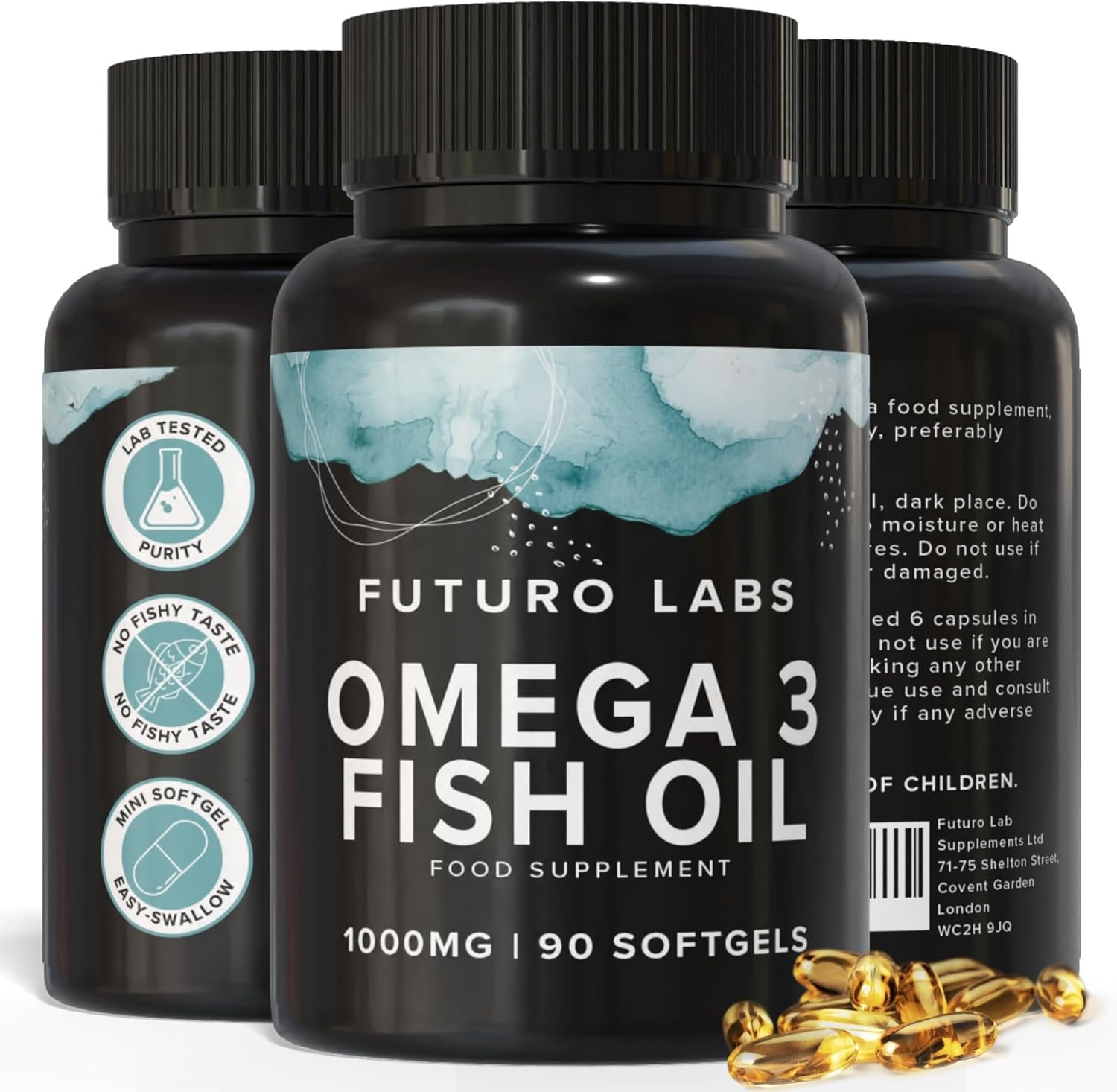
Futuro Labs Omega 3 Fish Oil
£14.99 for 90-day supply (90 softgels) · ~17p per day
Pros
- 1000mg fish oil per softgel — 180mg EPA + 120mg DHA stated
- Mini softgel, no fishy taste, lab tested
- 90-day supply at £14.99 (~17p/day), UK made
Cons
- Fish-derived, bovine-gelatin softgel — not vegan or vegetarian (algal DHA is that route)
- Ethyl-ester form — take with a meal; DHA brain/vision register claims need 250mg DHA daily, above the one-a-day serving
Available from: Amazon UK — £14.99
The honest purchase — sized exactly, then the constants
What buying a base-layer fish oil actually purchases, in this cluster's plain terms: coverage — EPA and DHA are essential, UK guidance widely suggests two fish portions weekly including one oily, the national plate reliably misses that line, and a one-a-day meeting the 250mg everyday condition closes the gap for the plates that have it (the sort by plate): Futuro Labs Omega 3 at 300mg EPA+DHA per mini softgel, £14.99 across 90 days at ~17p, is that purchase and describes itself as nothing grander (the record, limitations printed). What it doesn't purchase, kept in print: felt effects on any timeline (the tissue clock runs weeks to months, quietly — the timeline), the DHA-specific claims at standard ratios (120mg sits below that 250mg bar and this site says so), and anything from the marketing tier. The constants: with-a-meal is functional for concentrated oils (why); freshness is the category's real quality axis (the failure mode); and the label gates stand — pregnancy, nursing or any medication → doctor first per the label; blood thinners → the pharmacist conversation (that page). Does fish oil work, answered at last like an adult question: at what the register says, yes by definition; at what the miracle era promised, the trials answered; at what an honest buyer needs — a known gap covered for pennies — completely.
Frequently asked questions
Does fish oil actually work?
The three-layer sort this site runs on everything: the authorised layer — real conditioned UK sentences (heart at 250mg EPA+DHA; brain/vision at 250mg DHA; triglycerides and blood pressure at 2-3g) in maintenance grammar; the research layer — one of nutrition's largest evidence programmes, with genuinely mixed chapters (the big outcome-trial era cooled several early hopes) and genuinely solid ones (essential-fat biology, the pregnancy-DHA literature, prescription-dose triglyceride effects); the marketing layer — everything promising felt transformation, which no register sentence or trial underwrites.
Why did some big fish-oil trials disappoint?
Honest context: several large cardiovascular outcome trials in already-well-treated populations found little added benefit from supplemental doses — a real chapter that cooled the miracle era — while a high-dose prescription EPA trial succeeded and others didn't, leaving cardiology genuinely debating formulations and populations. None of that touches the maintenance claims' basis or the essential-nutrient case; it retires the cure-all framing.
So what's the honest reason to take it?
Base-layer logic, not miracle logic: EPA and DHA are essential fats most UK plates under-supply against the oily-fish guidance, the everyday claim's 250mg condition is a checkable daily benchmark, and a clean one-a-day meets it for pennies. Coverage of a known dietary gap — that's the purchase, sized exactly.