Long Term: Studied, Reassured, Reviewed — Never 'Forever-Proven'
The two-sided answer marketing never gives, the no-dependency signal in the reversion finding, and the periodic review that beats ritual cycling every time.
At a glance
- The evidence edge, stated: six months studied without serious signals · multi-year formally unstudied
- The real reassurances: endogenous molecule · mild file · reversion (no dependency mechanism)
- No cycling case: continuous repletion model — periodic review beats ritual off-weeks
- The long-term practices: label dose · self-review every few months · gates standing
What 'long-term safe' can and can't honestly mean here
The question deserves the two-sided answer marketing never gives: the studied side — trials ran daily oral GSH at 250-1000mg for up to six months with no serious adverse effects and only the mild digestive tier reported (that file), which is genuine medium-term evidence most of this shelf can't match; the unstudied side — multi-year daily supplementation has no formal trial record, so 'proven safe forever' is a sentence no honest page writes, here or anywhere in the supplement aisle. Between those sides sit the reassurances that are real rather than rhetorical: glutathione is the body's own molecule with continuous endogenous synthesis and turnover (supplementing tops up a native system rather than introducing a foreign one — the biology); and the reversion finding — stores drifting back toward baseline after stopping — doubles as a no-dependency signal: nothing about the model suggests the system stops working for itself (the trial's full shape).
The cycling question — ritual imported, evidence absent
The long-term searcher usually meets cycling advice within a page, so this cluster settles it: no cycling evidence or mechanism exists for glutathione — the repletion model is continuous by nature (daily intake builds stores; cessation reverses them; there's no receptor-desensitisation story or tolerance mechanism to 'reset'), the foundational trial ran uninterrupted daily dosing, and the five-days-on-two-off protocols circulating online are gym-culture habits travelling without their luggage (the daily page's same verdict). What replaces ritual cycling with something useful: the periodic review — every few months, ask the adult questions: does the reason I started still hold, is the budget line still earning its place, has anything changed (new medication being the big one — back to the pharmacist minute), and is the honest answer to 'would I start this today?' still yes. A supplement that survives that review is a choice; one maintained by inertia is just a subscription (that page's economics apply).
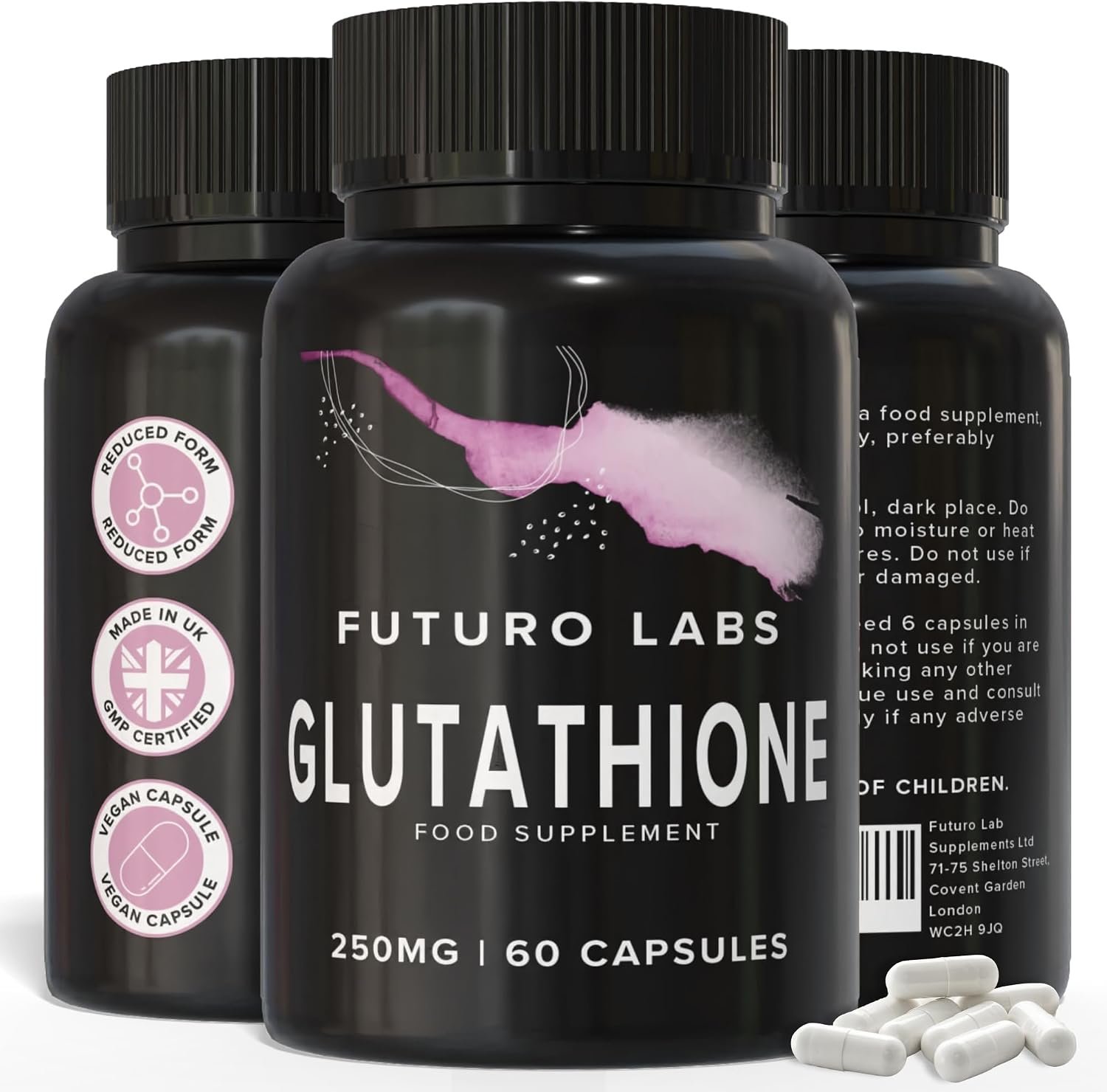
Futuro Labs Glutathione
£22.99 for 30-day supply · 77p per day
Pros
- 500mg reduced glutathione (GSH) per serving — the active form
- UK manufactured under GMP certification
- Single-ingredient, vegan, no fillers
- Independently lab tested — microbiology and heavy metals
- ~77p per day vs £1.20-1.80/day for liposomal formats
Cons
- Capsule format — no liposomal delivery system
- Newer brand versus heritage names like Solgar
Available from: Amazon UK — £22.99
The long-term architecture — practices that respect the edge
How this cluster does long-term honestly: label dose held — 500mg daily sits mid-range of the studied window, and years of megadosing is exactly the extrapolation the evidence edge cautions against (the map); the production inputs kept primary — protein sufficiency, sulfur vegetables, sleep and not smoking support the system a capsule only tops up, and they compound over years the way no supplement does (that hierarchy); the gates re-checked as life changes — new prescriptions reopen the pharmacist conversation every time (oncology treatment above all — the routing), and pregnancy planning resets everything to medical-advice-first; and the product kept auditable — Futuro Labs Glutathione's design serves the long habit specifically: single-ingredient reduced GSH (attribution stays clean across years), independent heavy-metals and microbiology testing (the contaminant question matters more, not less, over long horizons), vegan capsules with no fillers, £22.99/30 days at ~77p — the honest floor a multi-year line item can actually sustain (the record). Long-term, honestly: studied to six months, reassured by biology, reviewed by you — and never sold as forever-proven by anyone worth buying from.
Frequently asked questions
Is glutathione safe to take long term?
The honest framing: trials ran up to six months at 250-1000mg daily without serious adverse signals — solid medium-term evidence — while multi-year supplementation simply hasn't been formally studied, so 'proven safe forever' isn't a sentence anyone can honestly write. The reassurances that are real: it's the body's own molecule with continuous endogenous turnover, the studied file is mild, and stores revert after stopping (no dependency mechanism). The practices that respect the evidence edge: label dose, periodic self-review, and the standing gates.
Do I need to cycle glutathione?
No cycling evidence or mechanism exists: the repletion model is continuous (stores built by daily intake, reverting on cessation), trials ran uninterrupted daily dosing, and cycling protocols circulating online are imported gym-culture habits, not glutathione science. The honest alternative to ritual cycling: an actual periodic review — every few months, ask whether the reason you started still holds.
Does taking glutathione shut down my own production?
No evidence supports suppression: the reversion-after-stopping finding shows stores returning toward baseline — consistent with supplementation topping up a system that keeps running its own synthesis, not replacing it. Your production still depends on its inputs (protein, sleep, not smoking) regardless of any capsule — which is why this cluster ranks those first.