Concentration: Claims See Milligrams, Never Percentages
Real, costly engineering behind every strength adjective — with the freshness war mattering at least as much at high percentages.
At a glance
- The definition: the oil's omega percentage — ~30% natural body oil vs 60-90% concentrates
- The chemistry: molecular distillation enriching the EPA/DHA fraction — real engineering
- The rule: claims see milligrams, never percentages — 300mg is 300mg either way
- The honest buyer: high daily targets without capsule-counting — everyone else has headroom already
The percentage behind the milligrams — what concentration is
Concentration is the chemistry underneath half the shelf's adjectives, so this page defines it properly: fish body oil in its natural state runs around 30% omega-3 — the rest being the other fatty acids fish flesh carries — so a standard 1000mg capsule holds roughly 300mg of omega (of which the EPA+DHA pair is the claims-relevant share: the unit, the carrier decode); concentration processing changes that ratio — molecular distillation and selective esterification enrich the EPA/DHA fraction, pushing oils to 60%, 80%, even 90%+ omega content, so the same capsule size carries double or triple the payload: real, costly engineering, and the honest referent behind every 'high strength', 'extra strength' and 'triple strength' label the marketing pages decode (that decode, and that one).
The rule that keeps the shelf honest — claims see milligrams
The principle every concentration conversation needs bolted on: the register conditions on milligrams reaching you, never on percentages — 250mg of the pair for the everyday sentence, 250mg DHA for its gates, the multi-gram rungs above (the ladder) — so 300mg of EPA+DHA is exactly 300mg whether it arrived in one 60%-concentrate capsule or one standard 30% softgel: the percentage changes the packaging maths, not the biology, and 'stronger oil' delivers nothing 'weaker oil plus the same milligrams' wouldn't (the layers). What the percentage does honestly change: capsule count at high targets — a 2g professionally-set daily intake means seven standard softgels or two-to-three concentrates, and there the engineering earns its premium as capsule-count mercy (where such targets live, GP conversation attached); processing cost and price — enrichment is genuinely expensive, and concentrate premiums reflect real work rather than pure branding; and one quiet trade — more processing steps mean the freshness question (handling, antioxidants, testing) matters at least as much at high percentages, since the enriched polyunsaturate is exactly as oxidisable (the war at every percentage).
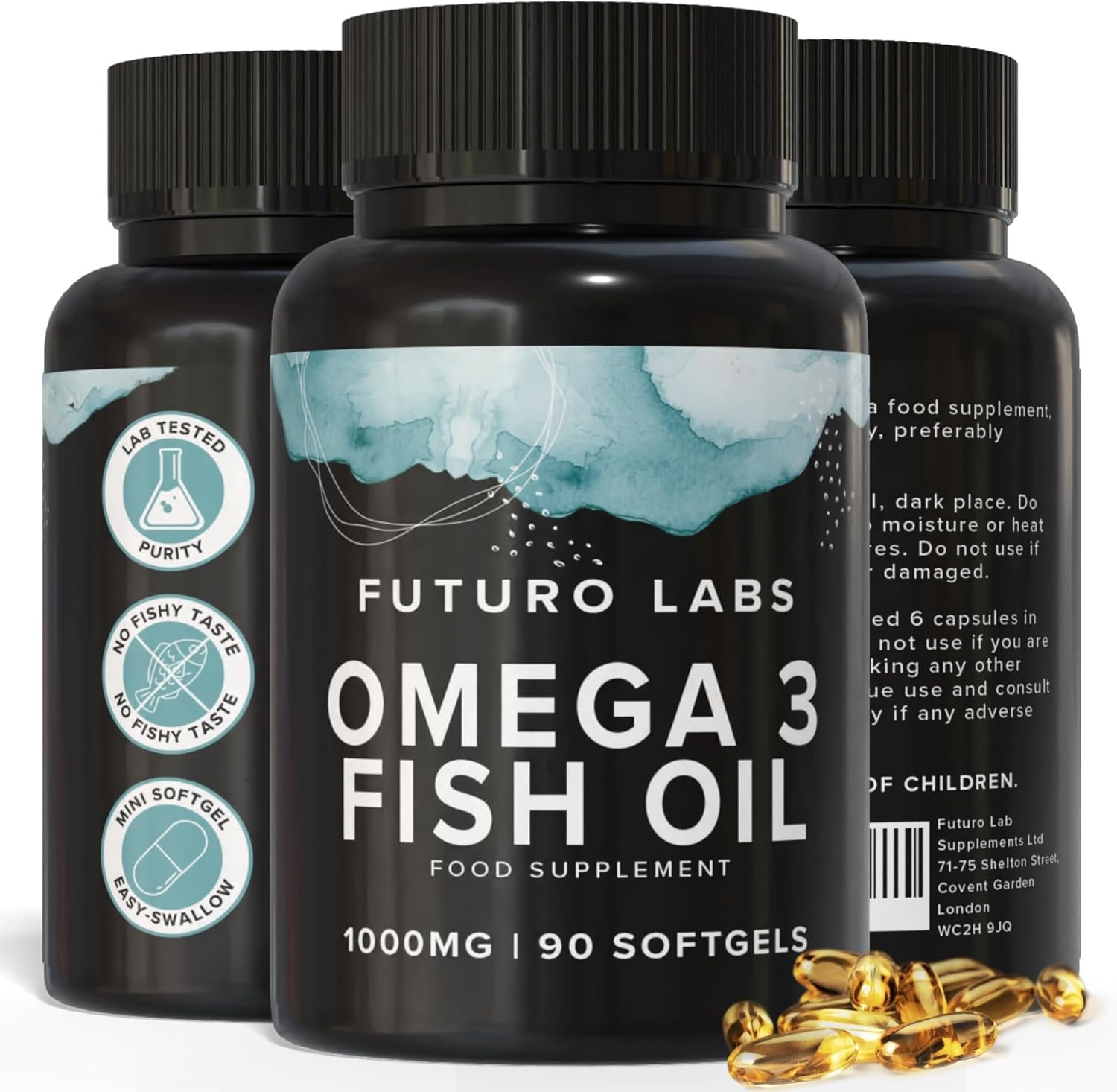
Futuro Labs Omega 3 Fish Oil
£14.99 for 90-day supply (90 softgels) · ~17p per day
Pros
- 1000mg fish oil per softgel — 180mg EPA + 120mg DHA stated
- Mini softgel, no fishy taste, lab tested
- 90-day supply at £14.99 (~17p/day), UK made
Cons
- Fish-derived, bovine-gelatin softgel — not vegan or vegetarian (algal DHA is that route)
- Ethyl-ester form — take with a meal; DHA brain/vision register claims need 250mg DHA daily, above the one-a-day serving
Available from: Amazon UK — £14.99
The routing, and the close
Who buys which percentage, sorted honestly: the everyday-condition buyer — the 250mg benchmark met at one standard-concentration softgel is the complete brief, and Futuro Labs Omega 3 is that sentence as a product: ~30% oil delivering 300mg of the pair at one, ~17p, the concentrate premium left unspent because the headroom already exists (the record); the high-target buyer — fishless plates aiming above the condition, and the professionally-advised working the ladder's upper rungs: the concentrate's honest customers, paying for capsule-count mercy knowingly (the tier audit, the head-to-head). Constants at every percentage: with-a-meal chemistry (the cascade); the panel read (the habit); gates as ever — pregnancy, nursing or any medication → doctor first per the label (the conversation). Concentration, explained to a close: real chemistry, honest premiums, one unbending rule — the claims count milligrams, and so should you.
Frequently asked questions
What does omega 3 concentration actually mean?
The percentage of the oil that is omega-3: natural fish body oil runs around 30% (a 1000mg capsule carrying ~300mg omega), while concentration processing — molecular distillation enriching the EPA/DHA fraction — pushes oils to 60-90% (the same capsule size carrying double or triple the payload). It's the chemistry behind every 'high strength' and 'triple strength' label.
Is concentrated fish oil better quality?
Different, not better: concentration is convenience engineering — more payload per capsule for high daily targets — bought with extra processing and price. The claims arithmetic never sees the percentage: 300mg of the pair is 300mg whether it arrived in one concentrated capsule or one standard one, and freshness plus testing remain the real quality axes at every percentage.
Should I pay for a concentrate?
Only if your daily target demands it: multi-hundred-to-gram intakes without capsule-counting are the concentrate's honest use case (fishless high-totals plates, professionally-set upper-rung doses). The everyday 250mg condition is met at one standard-concentration softgel, making the concentrate premium a payment for headroom you may never use.