Sea Moss vs Ashwagandha: Different Mechanisms, Shared Caution
The search usually means someone shopping a feeling both categories market at from opposite directions. The supply-signal sort, the fair one-liner on evidence, and the overlap that demands respect.
At a glance
- Category, not degree: mineral supply (sea moss) vs herbal signal (ashwagandha)
- Evidence kinds: settled nutrient science vs a genuinely promising botanical file
- The overlap to respect: BOTH touch thyroid territory — combination doubles the ask-first case
- The sort: supplying a gap vs trialling a signal — know which you're buying
Supply versus signal — the real difference
The comparison resolves at mechanism level: sea moss works by supply — contributing iodine and trace minerals your physiology uses as raw material, with iodine's authorised claim set defining the territory and adequacy-maintenance as the honest outcome (the map); ashwagandha works by signal — a Withania somnifera extract acting pharmacologically on stress-response systems, the adaptogen model where the plant's compounds do something to you rather than for your pantry. Supply questions sound like 'does my week under-provide this nutrient?' (the gap logic); signal questions sound like 'do I want to trial a botanical's effect on my stress load?' — different questions, different purchases, and the search that pairs them usually means someone shopping a feeling ('run down, stressed, off') that both categories market at from opposite directions.
Two evidence files, read fairly
At this site's standards, both files get their due: iodine's — settled nutrient science, claims authorised because the biology is beyond dispute, with sea moss's specific role being the measured whole-food delivery of it (variability printed, frame respected — that page); ashwagandha's — genuinely among the better botanical files: repeated small-to-mid human trials on perceived stress, anxiety measures and cortisol markers showing consistent-direction effects, enough that honest reviewers rank it above most of the herbal shelf — alongside the standing caveats: extract standardisation varies (KSM-66, sensoril and generic roots aren't one product), no UK-authorised claims exist, and the file is promising-unsettled rather than done. The fair one-liner: certainty about a nutrient versus promise about a herb — not a rankable pair, and pretending otherwise flatters whichever you were already selling.
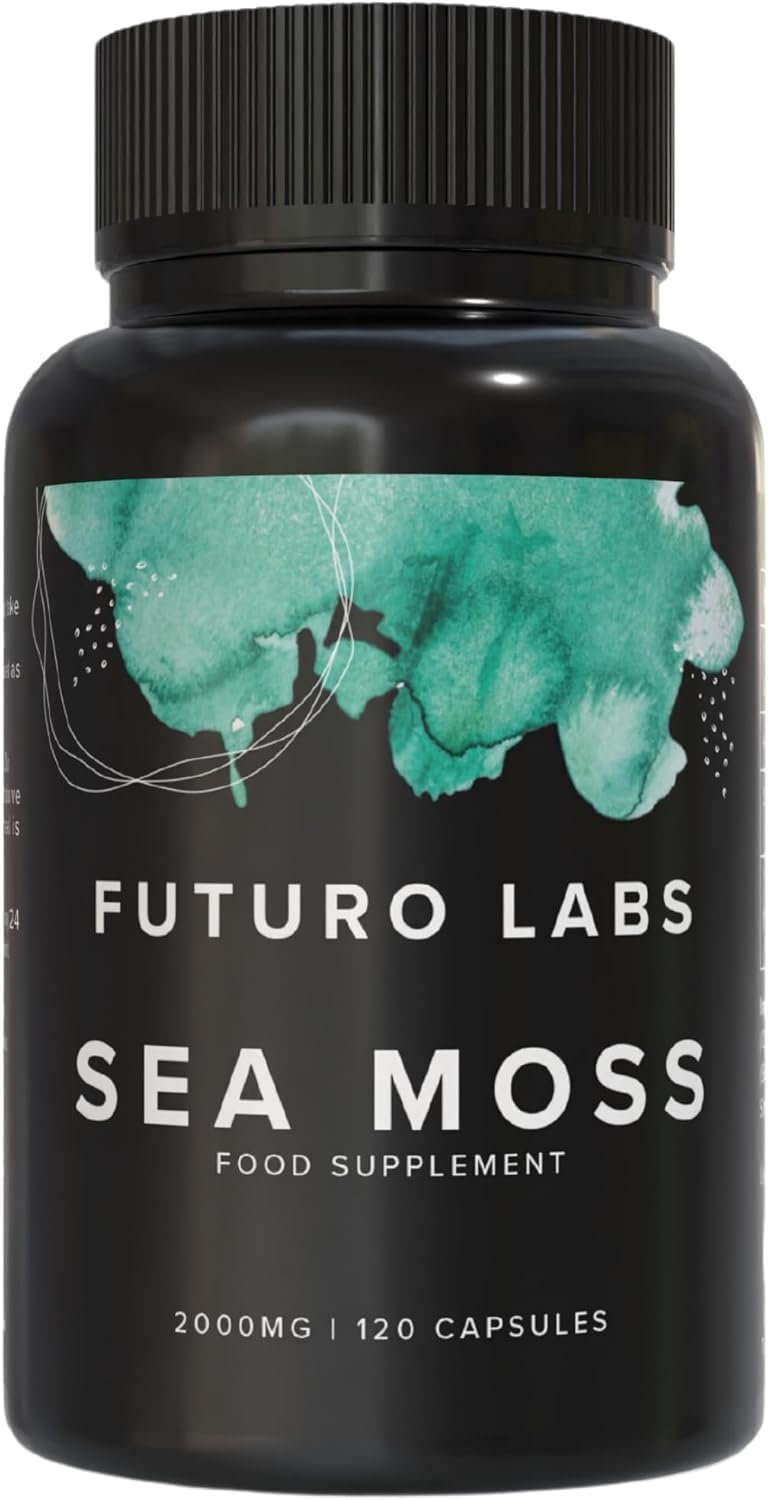
Futuro Labs Sea Moss
£9.99 for 60-day supply (120 capsules) · under 17p per day
Pros
- 2000mg raw sea moss equivalent per serving (15:1 extract)
- Wildcrafted North Atlantic Chondrus crispus — named species and origin
- Independently lab tested — heavy metals and microbiology
- Single-ingredient vegan capsules, UK GMP made
- 60-day supply £9.99 — under 17p/day
Cons
- Iodine content varies by harvest — not for precise-dose needs
- Young brand next to high-street names
Available from: Amazon UK — £9.99
The overlap that demands respect — and the combination rules
One shared territory turns this from a neutral comparison into a careful one: the thyroid. Sea moss touches it through iodine — the both-directions mineral this cluster gates relentlessly — and ashwagandha touches it too: the herb has reported effects on thyroid hormone measures in studies and case literature, enough that thyroid-condition cautions appear on responsible ashwagandha labels. The consequence writes itself: for anyone with a thyroid condition or on thyroid medication, the combination doesn't average out to fine — it doubles the professional-conversation case (our routing page applies twice over), and pregnancy excludes ashwagandha outright on most guidance while gating sea moss through the midwife. For everyone else combining: no direct interaction is documented, staggered starts keep attribution readable (the clock logic), and each product keeps its own rules — sea moss's one-serving architecture, ashwagandha's extract-and-dose label discipline. The closing sort: supply the gap if you have one, trial the signal if you want one, and let the thyroid paragraph above outrank enthusiasm either way.
Frequently asked questions
Sea moss or ashwagandha — what's the difference?
Category, not degree: sea moss is mineral nutrition (iodine's authorised claim territory — a contribution you supply); ashwagandha is a herbal adaptogen (a Withania extract acting pharmacologically, with a genuine modern trial file on stress and cortisol measures — larger than most botanicals — and still no authorised UK claims). Supply versus signal: different mechanisms, different questions, different cautions.
Which has better evidence?
Different kinds: iodine's nutrition science is settled (the claims are authorised because the biology is); ashwagandha's herbal file is genuinely better than most botanicals — repeated small-to-mid trials on perceived stress and cortisol — while remaining unauthorised-claim territory with dosing and extract-standardisation caveats. Nutrient certainty versus promising-botanical: not a rankable pair.
Can you take sea moss and ashwagandha together?
Commonly done, no direct interaction documented — but ashwagandha carries its own careful list (thyroid interactions are reported territory for the herb too, plus pregnancy exclusion and medication checks), which means the combination doubles the pharmacist-conversation case rather than waiving it. Anyone with thyroid conditions or medication has two reasons to ask first, not zero.