GSH vs NMN: Know Which Receipt You're Holding
The NAD+ programme respected as serious science priced years ahead of its file — category confusion prevented in both directions, the free list printed first.
At a glance
- Two real declines: NAD+ and glutathione both drift with age — parallel textbook facts
- The evidence split: NMN = promising hypothesis, early human data · GSH = direct repletion trial
- The price split: £40-80+/month vs 77p/day — aspiration priced above measurement
- Neither holds: authorised claims, lifespan evidence, or felt effects
Two declines, honestly parallel — then the fork
NMN and glutathione share the same opening chapter, which is why the comparison matters: both ride documented age-related declines — NAD+ levels drift down through adulthood (real, textbook, the foundation of the entire NMN category), and glutathione status does the same (that curve's honest page) — and both markets convert their decline into a supplement pitch. The fork is what happens next, and it's the whole comparison: NMN's pitch runs decline → precursor supplementation → hoped-for outcomes, with the middle step's human evidence early and the last step's absent — a promising research programme (NAD+ biology is serious science, the animal data genuinely exciting, human trials genuinely running) whose consumer products are priced years ahead of their file, typically £40-80+/month; glutathione's runs decline → supplementation → measured repletion, the middle step being the six-month human trial this cluster is built on: stores demonstrably rising on the actual supplemented molecule (the finding) — with the honest ceiling identical to NMN's: no outcome evidence beyond that endpoint, no lifespan data, no claims (the aisle's shared gap).
The purchases, described as what they are
Stripped to what money actually buys: the NMN purchase — a stake in a hypothesis: you're funding the bet that NAD+ restoration translates to human healthspan before the trials confirm it, at premium pricing that reflects the story's heat rather than its confirmation (the same structure as the resveratrol purchase, with a younger and arguably livelier research programme); the glutathione purchase — a measured repletion strategy: the narrow, unglamorous, checkable-in-principle endpoint the trial demonstrated, bought for that and nothing grander — quiet expected (the clock), reversion after stopping (the two-sided fact). Both purchases are legitimate for buyers who know which they're making; the error this page exists to prevent is category confusion — paying measurement prices for aspiration, or expecting aspiration's glamour from measurement (the sort that governs everything here).
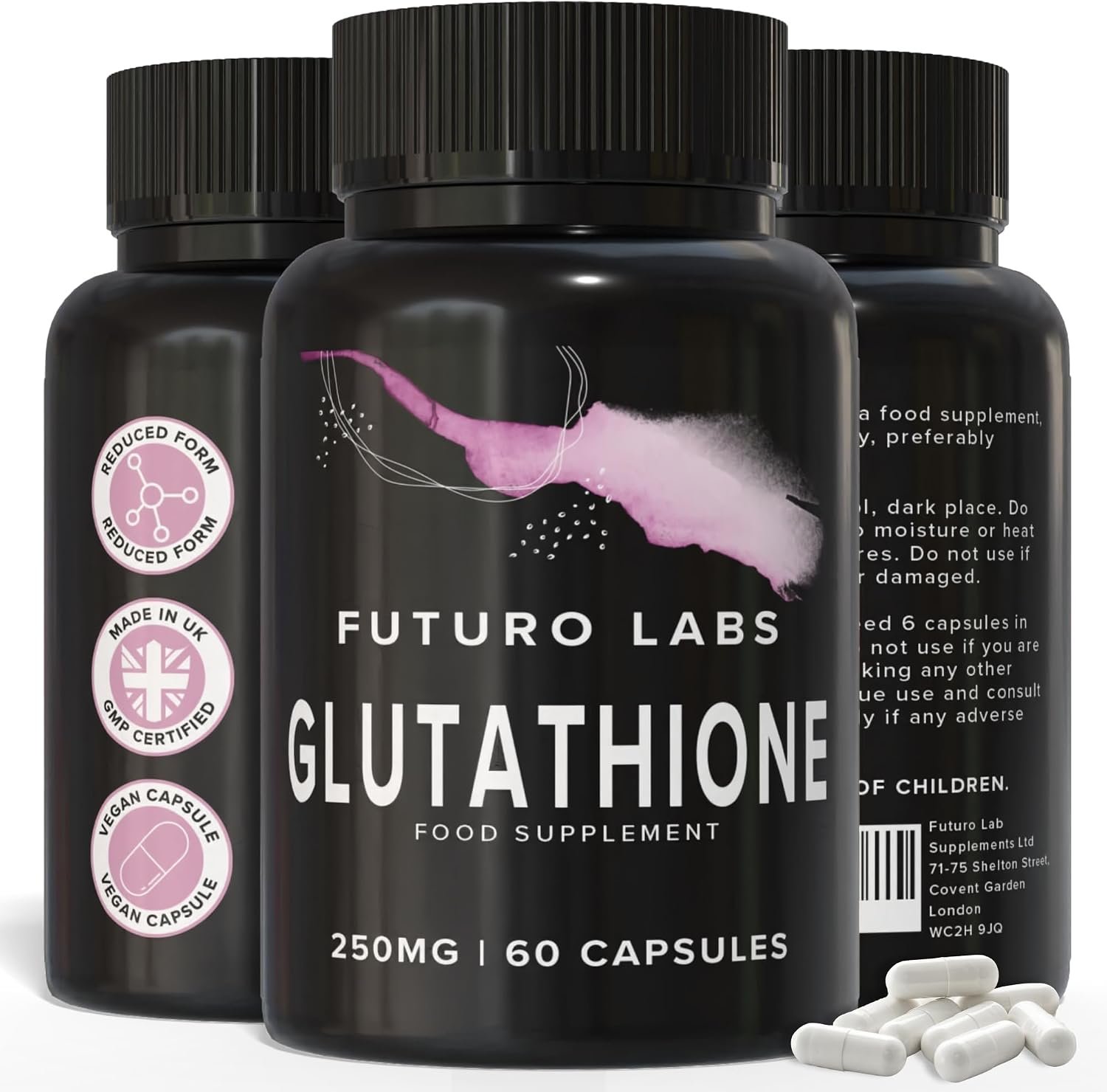
Futuro Labs Glutathione
£22.99 for 30-day supply · 77p per day
Pros
- 500mg reduced glutathione (GSH) per serving — the active form
- UK manufactured under GMP certification
- Single-ingredient, vegan, no fillers
- Independently lab tested — microbiology and heavy metals
- ~77p per day vs £1.20-1.80/day for liposomal formats
Cons
- Capsule format — no liposomal delivery system
- Newer brand versus heritage names like Solgar
Available from: Amazon UK — £22.99
The router — and the list that outranks both
Sorted by buyer: the evidence-first reader — the direct human trial decides, and Futuro Labs Glutathione runs it at the floor: 500mg reduced glutathione daily, single-ingredient, independently tested, £22.99/30 days at ~77p (the record); the frontier-funder — NMN taken knowingly as a hypothesis stake (research respected, translation gap owned, premium accepted as the price of early) is defensible speculation this page describes without joining; the both-stacker — permitted at label doses, disciplined by the stacks rules (staggered starts, per-line rationales, separate 12-week reviews — the disciplines), with £60-100+/month asked to justify itself against the list below. That list, printed as every longevity page here must: the interventions with actual human longevity evidence remain not smoking, activity, sleep, diet quality and connection — free, boring, unbeaten — and any stack conversation that hasn't had this paragraph first is running on the aisle's shared gap. Gates as ever: pregnancy/breastfeeding → medical advice; prescription medication → pharmacist minute (the routing). NMN versus GSH, closed: two real declines, one measured answer, one funded hope — know which receipt you're holding.
Frequently asked questions
Glutathione or NMN — which longevity supplement is better?
Two documented age-related declines, two very different purchases: NMN sells the NAD+ story — a real decline, compelling mechanism and animal data, early and unsettled human translation, typically £40-80+/month; glutathione sells its own real decline plus something NMN lacks: a direct human repletion trial for the supplement itself. Neither holds authorised claims or lifespan evidence; one at least offers a measured endpoint at 77p.
Is NMN's science legitimate?
The research programme is real and serious — NAD+ biology matters, the animal data generated genuine excitement, and human trials are running — but 'running' is the operative word: human outcomes remain early, mixed and modest, dosing is unsettled, and the field itself debates bioavailability and forms. Legitimate science, premature pricing: the file describes a promising hypothesis sold at proven-product prices.
Can you take both?
No interaction concern at label doses — but the stacks-page discipline applies doubled: two separate rationales (one measured, one aspirational), staggered starts, each line facing its own 12-week review, and the combined £60-100+/month asked to justify itself against the proven longevity list that costs nothing.