Sea Moss Nutrition: One Meaningful Line, Honestly Framed
The panel circulates in its most flattering costume, and the first skill is division. The macro truth, the mineral cast stated fairly, the food-league comparison, and the ten-second label habit.
At a glance
- The macro truth: negligible at real servings — sea moss is not a macronutrient food
- The panel trick: per-100g figures on a food eaten by the gram — divide before believing
- The one meaningful line: iodine — variable by harvest, framed by UK guidance
- The trace cast: real, modest, contribution-level — the 92-meme's honest replacement
The panel, read at real serving sizes
Sea moss nutrition facts circulate almost exclusively in their most flattering costume — the per-100g panel of a dried, concentrated food that nobody eats by the hundred grams — and the first skill this page teaches is division: real use runs a few grams (a gel spoonful at 2-4g of original moss, a capsule serving's raw equivalent), which is 20-to-50-fold below the panel's denominator, shrinking every macro line accordingly. Divided honestly, the macro story is quick: calories negligible, protein a trace, fat effectively absent, fibre a small genuine contribution from the polysaccharide matrix — sea moss is not a macronutrient food and no honest serving pretends otherwise. What survives the division intact is the micro story — because minerals were always the point, and one of them was always the headline (the 92-meme's audit covers the counting games this section replaces).
The lines that matter — iodine first, the cast behind it
The panel's one genuinely meaningful entry at supplement servings: iodine — the defining contribution, variable by harvest as all seaweed is (a truth honest labels print rather than average away), read against the UK frame of ~140mcg daily need and 500mcg upper ceiling from all sources (the full frame); this line alone carries the authorised claim territory that gives the category its legitimate core (the map). The supporting cast, stated at contribution level: potassium, magnesium, calcium, iron, zinc and companions accumulated from seawater — real presences that add small amounts to daily intake without individually starring at real servings; respectable whole-food behaviour, many modest lines, no stars beyond the first. And the matrix itself: the carrageenan-family polysaccharides that make sea moss gel, behave as soluble fibre, and carry the gut-relevant mechanics (that page) — structure counted as nutrition's delivery vehicle rather than its payload.
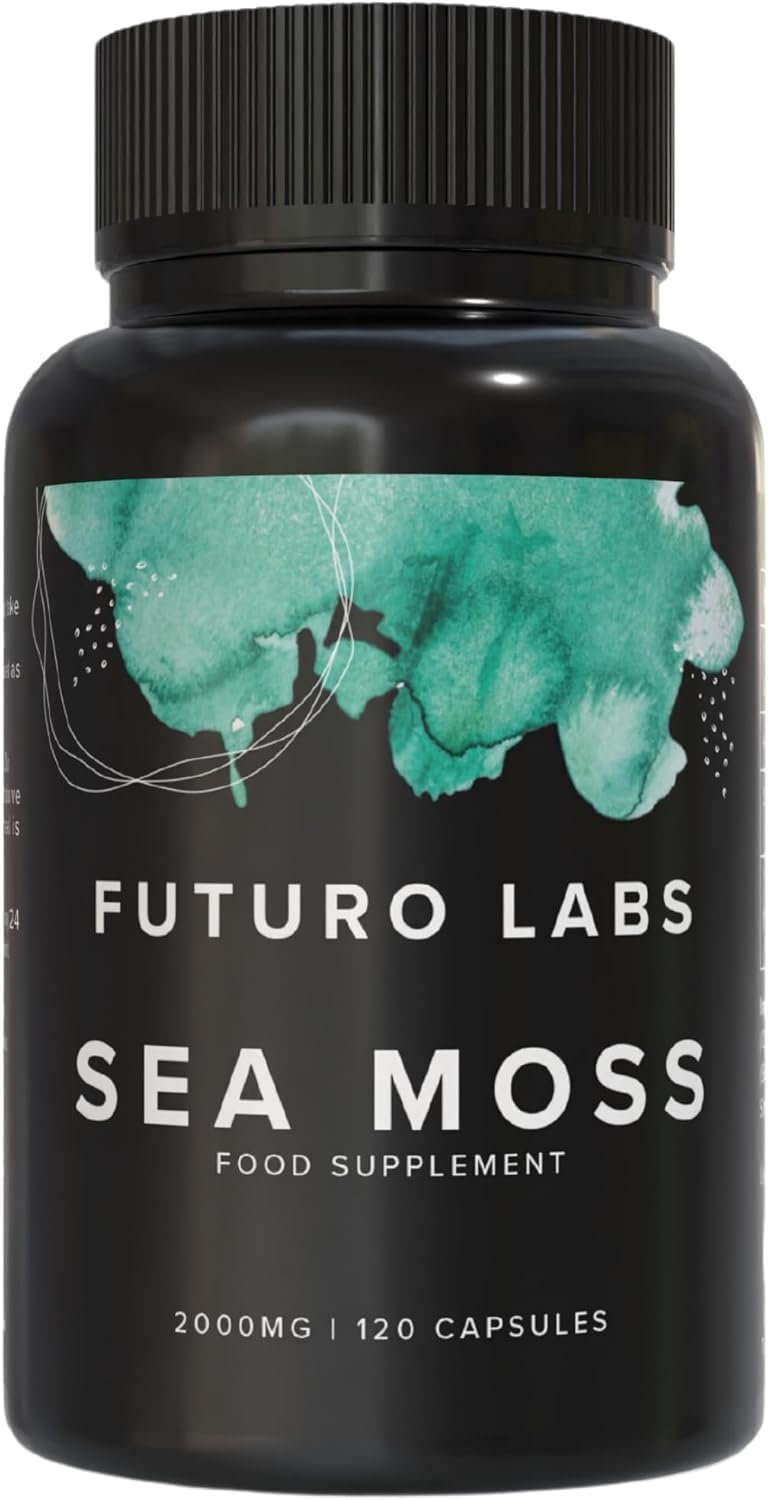
Futuro Labs Sea Moss
£9.99 for 60-day supply (120 capsules) · under 17p per day
Pros
- 2000mg raw sea moss equivalent per serving (15:1 extract)
- Wildcrafted North Atlantic Chondrus crispus — named species and origin
- Independently lab tested — heavy metals and microbiology
- Single-ingredient vegan capsules, UK GMP made
- 60-day supply £9.99 — under 17p/day
Cons
- Iodine content varies by harvest — not for precise-dose needs
- Young brand next to high-street names
Available from: Amazon UK — £9.99
Comparing foods fairly — and the label habit to keep
Where sea moss sits among iodine foods, serving-for-serving: white fish leads the league comfortably, dairy and eggs carry the population's quiet volume, and a measured sea moss serving competes respectably as the plant-shelf's contributor — which is exactly the shape of its honest constituency: the fish-free, dairy-light week where the panel's one meaningful line meets a genuine gap (that page). The label habit this page leaves you with: whenever a sea moss listing quotes nutrition, find the serving size first and divide before believing — per-100g panels on gram-serving foods are the category's legal flattery, and the division takes ten seconds; then check the line that matters is handled honestly (iodine acknowledged as variable, framed, gated — the serious lever) and the buying framework takes over from there (the five checks). Nutrition facts were never the argument for sea moss; one mineral, measured and verified, was — and the panel read honestly says exactly that.
Frequently asked questions
What is the nutritional value of sea moss?
As eaten (small servings), honestly modest on the macro panel: negligible calories, a little fibre, traces of protein — sea moss is not a macronutrient food. Its nutrition story is the micro line: iodine as the defining contribution, trace minerals accumulated from seawater, and the polysaccharide matrix that gives it food behaviour. Read any nutrition-facts panel with serving size in mind: per-100g figures flatter a food eaten by the gram.
Why do sea moss nutrition panels look so impressive per 100g?
Because nobody eats 100g: dried seaweed panels report a concentrated food at a serving size 20-50 times real use, inflating every line. The honest read divides by actual serving — a 2-4g gel spoonful or a capsule serving's raw equivalent — at which point the macro lines shrink to rounding errors and the story returns to where it belongs: the iodine contribution.
Is sea moss a good source of anything besides iodine?
Contribution-level traces: potassium, magnesium, calcium, iron, zinc and others at amounts that add to intake without individually starring at real serving sizes. That's respectable whole-food behaviour — many small lines — but the panel's one genuinely meaningful entry at supplement servings is iodine, which is why this cluster keeps the story there.