Post-Workout: Supply Line, Not Sports Drink
Training raises the case for baseline adequacy — supply logic, not performance logic. The heavy-lifters ranked, the conflation stopped, and the daily line at 17p.
At a glance
- The honest role: background mineral supply for training weeks — not performance, not recovery
- The electrolyte firewall: sodium-potassium-fluid arithmetic is a different game entirely
- The heavy-lifters: food, fluids, sleep — unbeaten and unglamorous
- Timing: irrelevant — anchor it to breakfast and forget choreography
What training weeks actually ask of minerals
The honest physiology first: regular training raises the general case for mineral adequacy — energy metabolism runs harder, sweat carries losses, and a body under consistent load benefits from its baseline being quietly covered — which is supply logic, not performance logic, and the distinction writes this whole page. Sea moss's contribution to that baseline is its usual one: iodine, holder of the normal energy-yielding metabolism claim (supply, not boost — the verb discipline), plus the trace-mineral company a whole seaweed brings at contribution scale (the divided panel's honest sizes) — background support for a training week, valuable exactly where diet under-supplies it (the fish-free athlete's genuine gap) and margin everywhere else. What it isn't, printed before any listing implies otherwise: a recovery accelerant, a performance aid, or anything the word 'workout' on a label can make it.
The electrolyte firewall — different game, different arithmetic
The conflation this page exists to stop: post-workout mineral talk usually means electrolytes — sodium, potassium and fluid replacement at gram-and-hundreds-of-milligram scales after heavy sweat — and sea moss doesn't play in that arithmetic: its sodium and potassium at real serving sizes are trace lines, orders of magnitude below the replacement conversation (the 92-meme's per-serving reality), so a capsule after a brutal session replaces essentially nothing the session took. Heavy sweat wants actual strategy — salted food and fluids covers most training; dedicated electrolyte products serve the long-and-hot sessions — while sea moss remains the background line running daily regardless (the architecture). The two jobs coexist happily; the firewall just stops one being sold as the other — and any listing marketing sea moss as workout electrolytes has failed arithmetic in public (the pattern file).
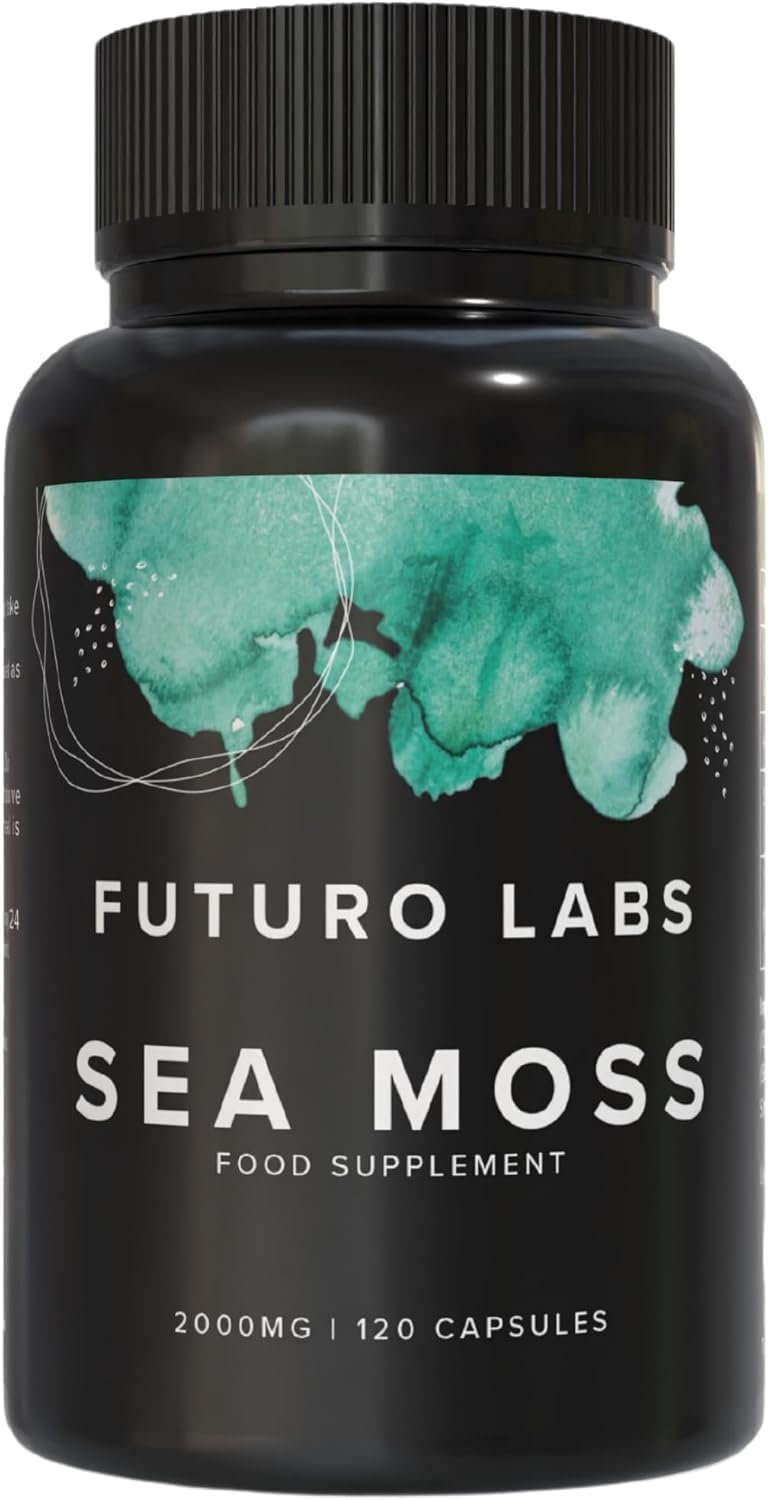
Futuro Labs Sea Moss
£9.99 for 60-day supply (120 capsules) · under 17p per day
Pros
- 2000mg raw sea moss equivalent per serving (15:1 extract)
- Wildcrafted North Atlantic Chondrus crispus — named species and origin
- Independently lab tested — heavy metals and microbiology
- Single-ingredient vegan capsules, UK GMP made
- 60-day supply £9.99 — under 17p/day
Cons
- Iodine content varies by harvest — not for precise-dose needs
- Young brand next to high-street names
Available from: Amazon UK — £9.99
The training-week protocol — boring, ranked, complete
The stack in evidence order, as this cluster always ranks it: food — protein and carbohydrate around training remain recovery's actual mechanism, unbeaten by any capsule; fluids — with sodium for the heavy-sweat sessions, per the firewall above; sleep — the recovery variable that dwarfs the supplement aisle combined; and then the background mineral line — Futuro Labs Sea Moss at its standard terms: one serving with breakfast (timing irrelevant to a supply nutrient — train at dawn or dusk, the anchor doesn't move — the two-minute protocol), 2000mg raw Irish sea moss equivalent via 15:1 extract, wildcrafted North Atlantic Chondrus crispus independently tested, £9.99/60 days at under 17p, judged across the 8-12 week window like everything else here (the clock). Constants for the training reader as for everyone: one product at label dose, never stacked (the arithmetic), and the gates — thyroid conditions, thyroid medication, pregnancy → GP, pharmacist or midwife first (the routing) — because a training habit changes nothing about the rules, only the value of the baseline they protect.
Frequently asked questions
Is sea moss good after workouts?
As general mineral support, modestly: training weeks raise the value of overall mineral adequacy, and a daily sea moss serving contributes iodine (energy-yielding metabolism's claim-holder) plus trace minerals to that baseline — supply for the system, not a performance or recovery product. The recovery heavy-lifters remain boring and unbeaten: food with protein and carbohydrate, fluids with sodium for heavy sweat sessions, and sleep.
Does sea moss replace electrolytes?
No — the electrolyte story is sodium, potassium and fluid at meaningful gram-and-hundreds-of-milligram scales, and sea moss servings carry trace amounts that don't play in that arithmetic. Heavy sweat sessions want actual electrolyte strategy (or just salted food and fluids); sea moss is the background mineral line, not the sports drink.
When should I take it around training?
Whenever it anchors best — timing is irrelevant to a daily-supply nutrient, so with breakfast remains the default whether you train at dawn or evening. Consistency across the 8-12 week window is the whole mechanism; pre- and post-workout choreography adds nothing.